-Jul-31-2026-08-39-51-8134-AM.png)
PODCAST ATTRIBUTION : HOW TO TRACK THE SALES YOUR PODCAST ADS ACTUALLY DRIVE
Podcast advertising works. US podcast ad revenue is now above four billion dollars, and studies put podcast long-term ROAS around 4.9x, well ahead of the roughly 3.7x average across media. The problem is not whether podcast ads drive sales. It is proving which ones do. Podcast is the hardest major channel to attribute, because a listener cannot click an ad mid-episode. They hear you on a morning commute, think about it for two days, then buy after a search later in the week, on a different device, through a path that looks nothing like the podcast that started it. Here is how to actually track the sales your podcast ads drive.
WHY PODCAST ATTRIBUTION IS SO HARD
Every other channel gives you a click. Podcast gives you a voice in someone's ears while they drive, walk, or wash dishes, with no device to click and often no connection at the moment of the ad. That creates three attribution problems at once.
No click means no automatic tracking. There is no pixel firing when someone hears your ad, so you cannot passively record the touch the way you can with a display or search ad.
Long and indirect paths. Listeners act hours or days later, and they rarely take the exact path you gave them. They hear a URL and Google your brand instead, or go straight to your homepage, or search your product category and find you organically.
Cross-device and offline. The ad is heard on a phone, often offline, and the purchase happens later on a laptop. Nothing connects those two events unless you deliberately build the connection.
THE METHODS THAT PARTIALLY WORK
There are four common podcast attribution methods, and the honest truth is that each captures only a slice.
Promo codes.
A unique code per show or episode, mentioned in the ad read, redeemed at checkout. Simple and good for direct-response offers, but industry benchmarks suggest 30 to 50% of conversions influenced by a podcast ad never redeem the code. People hear the ad, buy later, and never enter it. Promo codes systematically undercount, they measure the price-conscious listeners with good memory, not your full impact.
Vanity URLs.
A memorable custom URL, such as yourbrand.com/showname, spoken in the ad. Clean when it works, but many listeners will not type it exactly, they hear it and Google your brand instead, or land on your homepage. The vanity URL catches your most engaged listeners and misses everyone who took an indirect route.
Pixel-based tracking.
Some networks drop a device ID when a listener streams an episode on their app, then match it if that device later converts. This catches conversions promo codes and URLs miss, but it only works for listeners who stream on that network's platform, not Apple Podcasts, Spotify, or other apps, and privacy limits cross-device matching.
Surveys.
A "how did you hear about us" question at checkout catches the brand-search tail that the other methods miss. Directional and useful, but self-reported and incomplete.
Notice the pattern. Every method captures a different partial slice, and none of them sees the whole picture on its own.
THE REAL ANSWER : MULTI-SIGNAL PLUS MULTI-TOUCH ATTRIBUTION
Because each method catches a different fragment, the only way to see podcast's true contribution is to combine them and then reconcile everything against your actual sales. Use a speakable vanity URL for the online-right-away buyers, a unique promo code for checkout attribution, UTM parameters behind the vanity URL for the show-notes clicks, and a survey to catch the brand-search tail. That multi-signal setup captures far more than any single method.
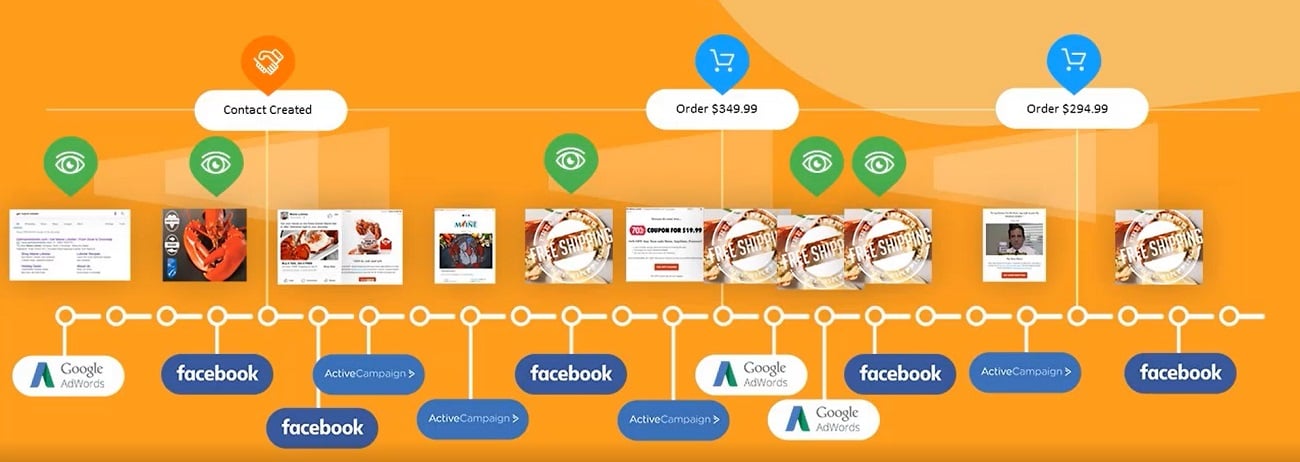
But capturing the signals is only half of it. You still have to connect those podcast touches to the eventual sale, which often closes days later through search or direct traffic on another device. That is a multi-touch attribution problem, and it is exactly the kind every platform gets wrong, because each one only sees its own slice and credits the last click it can see. Left to the platforms, your podcast ad gets no credit and your branded search or direct traffic gets all of it, even though the podcast is what actually created the demand.
Accurate podcast attribution means tying every one of those signals, the vanity URL click, the promo code, the UTM, the later purchase, to a real person and a real order across the full journey. That is what Wicked Reports does. It reconciles your podcast-driven traffic and codes against your real sales data across channels and devices, so the podcast gets credit for the demand it created rather than watching another channel claim it. See how it works in the platform overview, or book a demo to see it on your own data.
A NOTE ON JUDGING PODCAST CAMPAIGNS
One last thing that trips up advertisers. Podcast ads typically take three to five episode cycles before results accumulate meaningfully, and listeners convert on a delay. So judge a campaign across a full flight, not after one episode, and expect your click counts and recorded conversions to differ because of cookie windows and cross-device gaps. Track the trend and the true attributed revenue, not an exact match between any two numbers.
FAQ
HOW DO YOU TRACK SALES FROM PODCAST ADVERTISING?
Because listeners cannot click mid-episode, you combine several signals, a unique promo code for checkout attribution, a speakable vanity URL with UTM parameters behind it for online buyers, pixel tracking where the network supports it, and a "how did you hear about us" survey for the brand-search tail. Then you reconcile all of it against your real sales with multi-touch attribution to see podcast's true contribution.
WHY DO PROMO CODES UNDERCOUNT PODCAST SALES?
Because 30 to 50% of conversions influenced by a podcast ad never redeem the code. Listeners hear the ad, visit your site later, and buy without entering it, or they Google your brand instead of using the code or URL. Promo codes measure only the price-conscious listeners with good memory, not the full impact of the campaign.
WHY IS PODCAST HARDER TO ATTRIBUTE THAN OTHER CHANNELS?
Because there is no click. The ad is heard, often offline on a phone, and the purchase happens hours or days later on another device through an indirect path such as a brand search or a direct visit. Nothing automatically connects the ad to the sale, so podcast attribution requires deliberately capturing multiple signals and reconciling them against real orders.
HOW LONG SHOULD I RUN A PODCAST CAMPAIGN BEFORE JUDGING IT?
Typically three to five episode cycles, because results accumulate over time and listeners convert on a delay. Judging a podcast campaign after a single episode badly undercounts it. Evaluate performance across a full flight, track the trend in true attributed revenue, and expect click counts and recorded conversions to differ due to cross-device and cookie-window gaps.