

-2.png)
THE MISSING PIECE OF ECOMMERCE GROWTH : WHY MOST STORES ARE GUESSING
Growing an ecommerce store is like assembling a puzzle with four critical pieces. Miss any one and the picture never comes together. Most stores nail three of them and are quietly missing the fourth, which is exactly the one that tells them whether the other three are working. Here is the puzzle, and the piece almost everyone is missing.
THE FOUR PIECES OF ECOMMERCE GROWTH
1. Generate high-quality visitors.
Traffic from ads, content, social, and search that is actually likely to buy.
2. Capture and nurture leads.
Turn those visitors into leads and warm them up with email and follow-up.
3. Convert leads and visitors into customers.
The ecommerce fundamentals and automated follow-up that close the sale.
4. Know exactly how well each piece is working.
Accurate measurement of every part of your marketing, so you know which levers to pull to scale.
You need all four. And almost every small ecommerce store is completely missing piece number four. They do not have accurate measurement of how each part of their marketing is performing, so they are guessing at how to grow. They are experimenting rather than executing on a data-driven plan. Worse, they are often misled by the little data they do have, because they are relying on the reporting handed to them by Facebook, Google, and their email tool.
THE PROBLEM WITH PLATFORM REPORTS THAT NOBODY TALKS ABOUT
Most stores monitor and optimize their ads using the platforms' own reports, and those reports have serious problems built in.
They count conversions, not revenue. Facebook and Google give you a conversion count but not the actual revenue each ad produced. That leads you to undervalue some ads and overvalue others. To know how much you can spend on an ad and stay profitable, you have to know the revenue it creates, and a conversion count does not begin to tell you that.
Every platform grades its own homework. It is in each platform's interest to claim as many sales as possible, whether or not it actually drove the converting click. Facebook and Google cannot see that the real last touch was your email, or a referral, or another channel, and they will happily claim a sale if the buyer was recently exposed to one of their ads. That inflates your Facebook and Google numbers and undervalues everything else in your marketing.
They only see a short window. Platform reporting is capped to a window of time, so it cannot tell you how many orders a customer made over their lifetime or what those orders were worth. Repeat purchases and subscriptions simply vanish, never credited to the ad that created the customer. An ad might look weak on first-purchase revenue but bring in high-value customers who buy again and again, returning an excellent long-term ROI. First-purchase revenue can never show you that.
With email and marketing automation, it is even worse. Stores relying on ActiveCampaign, Drip, Mailchimp, or Klaviyo reporting get opens and clickthroughs, not revenue. For most stores, automated follow-up is a black hole, they have a vague sense it is working but cannot attribute a single sale to a specific campaign or sequence.
THE MISSING PIECE IS PEOPLE-BASED REVENUE ATTRIBUTION
The way to finally solve piece number four is to tie every touch in the customer journey, each ad click, each email clickthrough, each visit, to real customers, to their real orders, to the revenue those orders produced, and across the entire lifetime of the customer.
That is the whole game. With that data you are no longer flying blind. You can see that a particular Facebook ad generates 20,000 dollars in real revenue, so you know how far you can profitably spend to get more of it. You can see that an email campaign drives thousands of clicks but almost no sales, so you can fix it, split-test it, or cut it. You can see that your best, highest lifetime value customers come from one specific Google ad, so you pour more into it and reverse-engineer it to find more customers like them.
DATA SCIENCE FOR SMALL STORES
Large retailers like Amazon and Walmart have data science teams to maintain databases, run queries, and crunch these numbers on demand. As a small business you cannot afford that, and most attribution and analytics tools are either too expensive or too hard to set up and use. So are you stuck relying on the incomplete reporting of Facebook, Google, and your email tool? No.
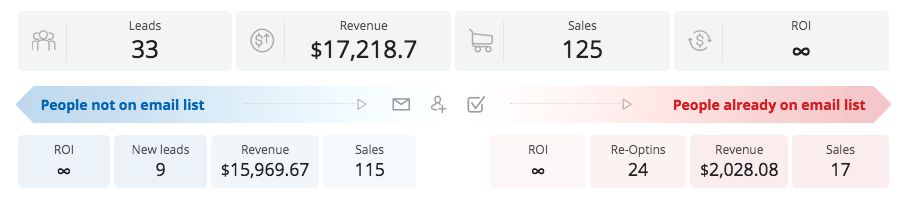
Wicked Reports was built for small, growing ecommerce stores. With one-click integrations you authorize your ad accounts, your email tool, and your ecommerce platform, and the data starts flowing, no programmer required. Using people-based tracking, it ties clicks to real people and their real orders, so you know exactly how much revenue each ad and email campaign generates over time, and the true ROI of each. Then it maps that to the customer lifecycle, so you can see which marketing creates awareness, which creates leads, which creates customers, and which creates repeat customers.
That is the missing piece. Once you have it, growth stops being guesswork. For a related take on where ecommerce marketing is heading, read the three new truths of ecommerce marketing, and when you are ready see how it works in the platform overview or book a demo to see it on your own store.
FAQ
WHAT IS THE MISSING PIECE OF ECOMMERCE GROWTH?
Accurate measurement of how each part of your marketing is performing. Most stores handle traffic, lead capture, and conversion but cannot see which campaigns actually drive revenue and profit, so they guess. Without people-based revenue attribution tying ads and emails to real orders over the customer lifetime, they are optimizing on incomplete platform reports.
WHY ARE FACEBOOK AND GOOGLE REPORTS MISLEADING?
Because they count conversions rather than revenue, claim credit for sales other channels actually drove, and only measure a short window that ignores repeat purchases and lifetime value. Each platform grades its own homework, which inflates its own numbers and undervalues the rest of your marketing, leading to poor budget decisions.
WHY ISN'T EMAIL REPORTING ENOUGH TO MEASURE ROI?
Email and automation tools like ActiveCampaign, Drip, Mailchimp, and Klaviyo report opens and clickthroughs, not the revenue a campaign produced. For most stores that makes automated follow-up a black hole, they sense it works but cannot attribute specific sales to specific sequences. Revenue attribution across the full journey is what reveals which emails actually make money.
WHAT IS PEOPLE-BASED REVENUE ATTRIBUTION?
It is tying every marketing touch, each ad click, email clickthrough, and visit, to real customers, their real orders, and the revenue produced over the customer's entire lifetime. Unlike platform reporting, it shows the true ROI of each ad and email across the whole journey, so you know which marketing to scale and which to cut.

-3.png)